In the field of optical communication, the Variable Optical Attenuator (VOA) plays an indispensable role. As a key component for optical power regulation, VOA not only guarantees the stable transmission of optical signals but also improves the overall performance of the system.
A variable optical attenuator is a passive optical device designed to achieve controllable attenuation of optical power. It precisely adjusts the energy of optical signals to meet the requirements of diverse application scenarios. VOAs are mainly divided into two categories: Mechanical Variable Optical Attenuators (MVOAs) and Electrical Variable Optical Attenuators (EVOAs). MVOAs realize optical power attenuation via manual adjustment, while EVOAs alter attenuation levels by applying driving electrical signals, boasting superior adjustment accuracy and flexibility.
VOAs adopt a wide range of working mechanisms, mainly including mechanical, magneto-optic, liquid crystal, MEMS (Micro-Electro-Mechanical System), thermo-optic and acousto-optic types.
1. Mechanical Type: The optical power in the light path is adjusted by moving light-blocking components such as sheets or cones. This design features a simple structure yet relatively low adjustment accuracy and flexibility.
2. Magneto-optic Type: Attenuation of light energy is realized by leveraging the changes in optical properties of substances under magnetic fields, namely the magneto-optic rotation effect. This type delivers high precision and stability but comes with a higher cost.
3. Liquid Crystal Type: Based on the birefringence effect arising from the refractive index anisotropy of liquid crystals, an external electric field is applied to reorient liquid crystal molecules, thereby tuning light transmittance. Liquid crystal VOAs feature fast response speed and wide attenuation range.
4. MEMS Type: Micro-mirrors fabricated with micro-electro-mechanical technology are tilted through electrostatic force to adjust reflected light intensity. MEMS VOAs are characterized by small size, light weight and high integration level.
5. Thermo-optic Type: Attenuation levels are modulated via variations in material optical properties (e.g., refractive index) under temperature fields. Thermo-optic VOAs have a simple structure and low cost, yet suffer from slow response speed.
6. Acousto-optic Type: Ultrasonic waves generate periodic strain inside acousto-optic crystals, inducing periodic fluctuations in refractive index to modulate light beams. Acousto-optic VOAs offer fast tuning speed and excellent stability.
VOAs are widely deployed in optical communications, fiber-optic sensing, optical instruments and other fields.
1. Optical Communications: Balance the intensity of optical signals across different channels to maintain consistent signal quality; adjust optical signal power to adapt to varying transmission distances and receiver specifications.
2. Fiber-optic Sensing: Simulate optical signal intensities under diverse environmental conditions to test and verify system performance and reliability.
3. Optical Instruments: Applied to laser devices, photon counters, spectrometers, optical microscopes and other equipment to control optical signal intensity and flux for accurate measurement results.
| Items | Parameters | Unit |
|---|---|---|
| Operating Wavelength Range | O band /C band/L band/Full band/others | nm |
| Attenuation Type | Bright or Dark | - |
| Attenuation Range | ≥15/20/30/40 | dB |
| Insertion Loss | ≤0.7 | dB |
| Attenuation Resolution | Continuous | dB |
| Return Loss | ≥45 | dB |
| Fiber Type | SMF-28e | - |
| Response Time (10-90%optical power) | ≤5 | ms |
| Driving Voltage | 5/6.5 | V |
| Driving Power | ≤5 | mW |
| Polarization Dependent Loss | ≤0.2@ 10dB , ≤0.5 @<20dB att. | dB |
| Wavelength Dependent Loss | ≤0.6@ 10dB , ≤1.0 @<20dB over 20nm span | dB |
| Maximum Optical Power | ≤500 | mW |
| Operating Temperature | -0~+70 | °C |
| Storage Temperature | -40~+85 | °C |
| Connector Type | Customized | - |
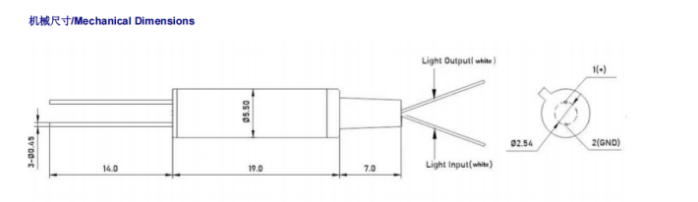
| Package size | Φ5.5xL19 | mm |
| Parameter | 1310 | 1550 | 1310/1550 | 850/1310 |
|---|---|---|---|---|
| Type(nm) | 1310 | 1550 | 1310/1550 | 850/1310 |
| Wavelength (nm) | 1310±50 | 1550±50 | 1260~1650 | 850/1310±40 |
| Attenuation Range (dB) | 0.8~60 | 0.8~60 | 0.8~60 | 0.8~60 |
| Original Loss (dB) | ≤0.8 | ≤0.8 | ≤0.8 | ≤0.8 |
| Return Loss(dB) | ≥50 | ≥50 | ≥50 | ≥30 |
| Fiber Type | SMF-28e | SMF-28e | SMF-28e | 50/125 or 62.5/125MM |
| PDL(dB) | ≤0.15 | ≤0.15 | ≤0.15 | - |
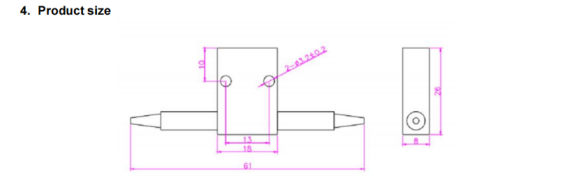
| Dimension (mm) | 26×18×8 | 26×18×8 | 26×18×8 | 26×18×8 |
| Operating Temperature(℃) | 0~+70 | 0~+70 | 0~+70 | 0~+70 |
| Storage Temperature(℃) | -40~+85 | -40~+85 | -40~+85 | -40~+85 |
Copyright @ 2020 Shenzhen Box Optronics Technology Co., Ltd. - China Fiber Optic Modules, Fiber Coupled Lasers Manufacturers, Laser Components Suppliers All Rights Reserved.