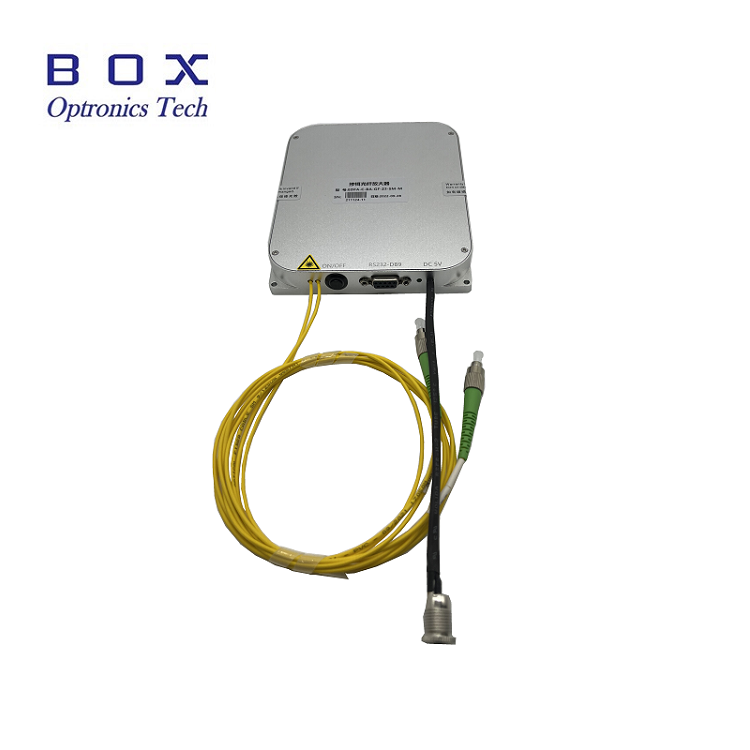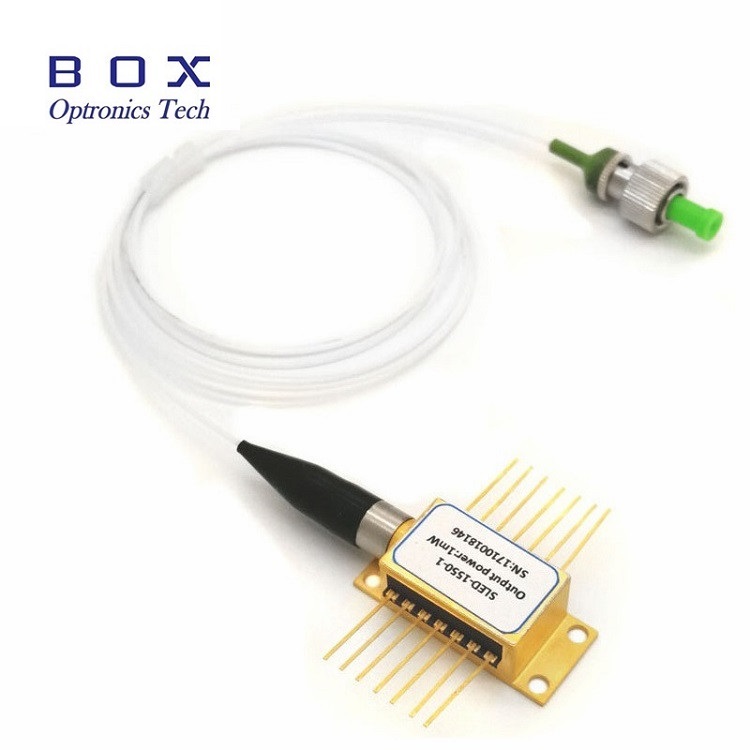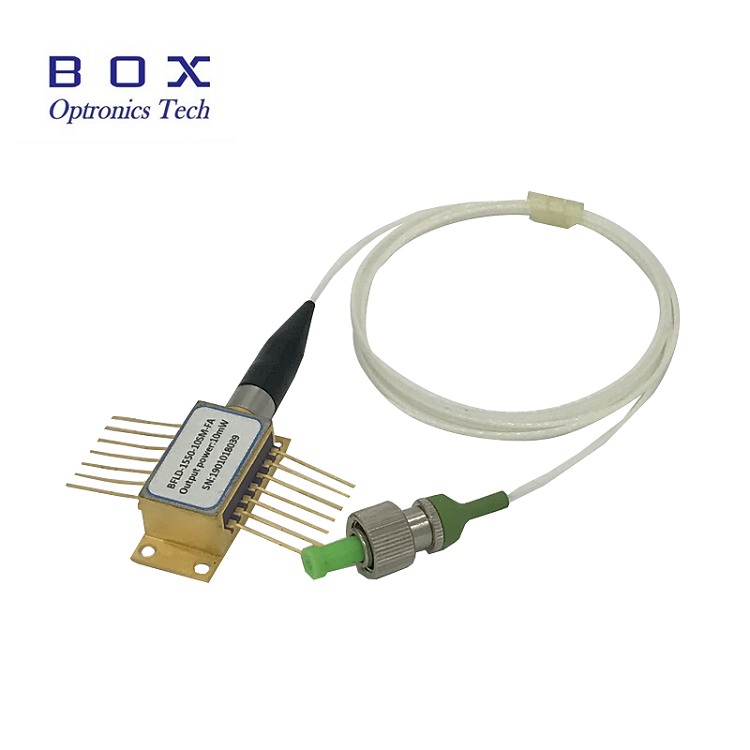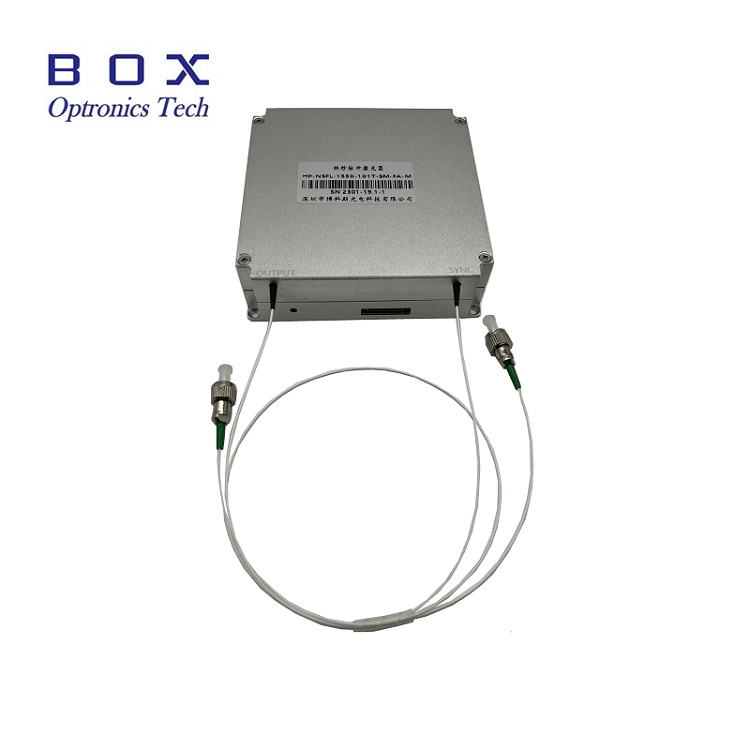
ASE broadband light sources are widely used in production testing and scientific research experiments. This article attempts to briefly explain the main parameters and testing methods of C+L band erbium-doped fiber ASE broadband light sources.
Working Principle ASE broadband light generated by erbium-doped fiber is amplified spontaneous emission light generated by short-wavelength laser pumping erbium-doped fiber. As shown in the schematic diagram below, the pumped rare-earth ions transition between upper and lower energy levels, generating spontaneous emission light, which is amplified during stimulated emission. This process repeats continuously, and under sufficient pumping conditions, it can even achieve a considerably high output power.
(ASE = Amplified Spontaneous Emission)
ASE radiation is prevalent as noise light in fiber lasers and fiber amplifiers. ASE light usually competes with the signal wavelength laser for gain, causing a decrease in effective laser power, a reduction in laser signal-to-noise ratio, and a decrease in polarization. Therefore, it is desirable to minimize the occurrence of ASE light in fiber lasers and fiber amplifiers. When designing fiber lasers and amplifiers, the power proportion of ASE light is reduced as much as possible by optimizing the optical path structure. However, ASE light as a light source also possesses certain characteristics, such as a wide spectral range, flat spectrum, low coherence, and low polarization, which are not found in laser light sources. Furthermore, fiber optic ASE light sources, generated within single-mode erbium fiber, can couple with ordinary single-mode fiber with almost no loss. Therefore, this type of broadband ASE light source has important applications in certain situations, such as fiber optic gyroscopes, fiber optic sensing, OCT imaging, and power compensation in optical communication channels.
In practical C+L band fiber ASE broadband light source products, erbium-doped silica fiber is typically used as the active medium, and a 980nm semiconductor laser is used as the excitation pump to generate spontaneous emission in the C band, which is then amplified through stimulated emission. Because the erbium-doped fiber has a certain length, the C-band radiation is absorbed by other erbium ions and re-radiated, causing the radiation wavelength to shift to a longer band. This radiation is then amplified again through stimulated emission, ultimately resulting in a broadband ASE spectrum covering the C or L bands. Different optical path structures can be designed to obtain ASE light source products with different wavelength bands, such as C, L, and C+L.
The above shows the optical path for testing the ASE radiation spectrum of Er-doped fiber. The isolator is a fiber optic isolator, and the WDM is a 980/1550nm fiber wavelength division multiplexing (WDM). A 974nm single-mode pumped LD provides the pump laser, which is coupled to excite a section of single-mode Er-doped fiber via the WDM. The emitted backward and forward ASE light is output through two separate isolators. Under the same pump power, the measured backward ASE spectrum (green line) and forward ASE spectrum (blue line) are shown in the figure. It can be seen that the ASE radiation spectrum directly emitted by the Erbium-doped fiber is not flat; the power density difference between different wavelengths can reach more than 10dB, and the ASE spectra in the two directions are not completely identical. Therefore, in fiber optic ASE broadband light source products, spectral flattening technology (filters) is required to achieve a flat output spectrum.
Copyright @ 2020 Shenzhen Box Optronics Technology Co., Ltd. - China Fiber Optic Modules, Fiber Coupled Lasers Manufacturers, Laser Components Suppliers All Rights Reserved.