In modern optical fiber communication systems, Erbium-Doped Fiber Amplifiers (EDFAs) are core devices that enable direct optical signal amplification to support long-haul and high-capacity transmission. Pump lasers, as the "power source" of EDFAs, are critical to determining their noise figure, gain, efficiency, and reliability. Currently, 980 nm pump lasers are the preferred choice for the vast majority of EDFA applications, a choice driven by the deep compatibility between their wavelength characteristics and the operating logic of EDFAs, as well as their multiple advantages in efficiency, performance, and reliability.
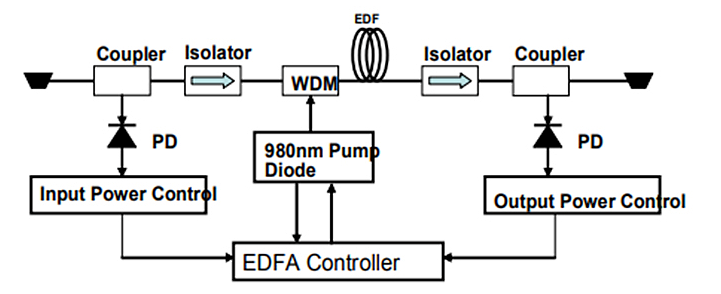
To understand the suitability of 980 nm pump lasers, it is first necessary to clarify the "cooperative relationship" between EDFAs and pump sources. An EDFA acts as a "signal booster". Its erbium-doped fiber contains a large number of erbium ions, which function as "energy carriers". Normally, these ions are in a low-energy state and cannot amplify signals. The role of the pump laser is to emit laser light at a specific wavelength to "charge" the erbium ions, exciting them to a high-energy state. When a weak communication signal passes through the erbium-doped fiber, the high-energy erbium ions release energy, multiplying the number of signal photons and thus achieving signal amplification.
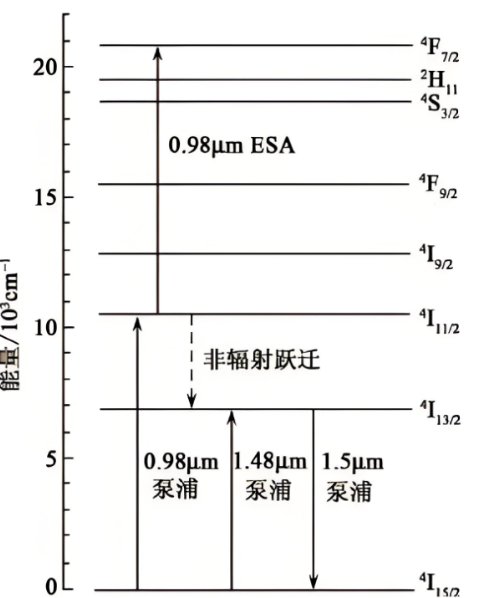
The key here is the "specific wavelength": only laser wavelengths that match the erbium ion absorption peak can efficiently complete energy transfer. Currently, the two mainstream pump wavelengths for EDFAs are 980 nm and 1480 nm. The 980 nm wavelength has become the preferred choice for most EDFA scenarios due to its superior energy conversion efficiency and noise control capabilities, which is the core premise for the widespread adoption of 980 nm pump lasers in EDFAs.
The selection of 980 nm pump lasers for EDFAs essentially stems from their wavelength characteristics perfectly meeting the core requirements of EDFAs. This can be broken down into several key advantages, which are the key reasons why 980 nm EDFA pump lasers have become industry mainstream.
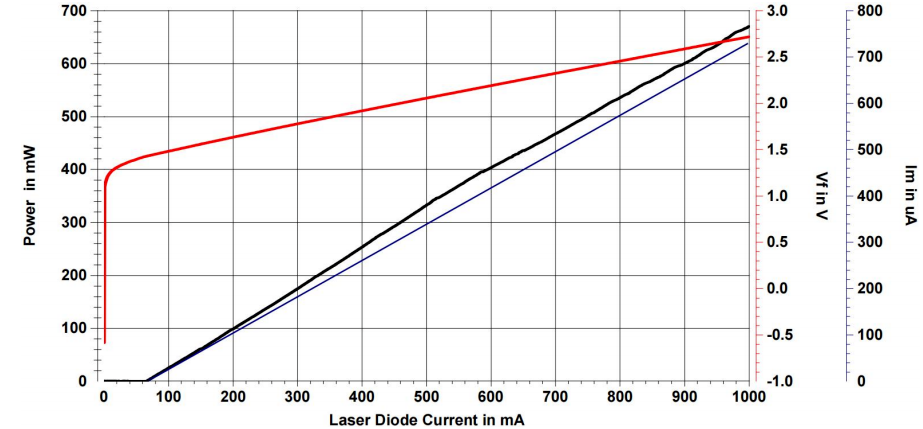
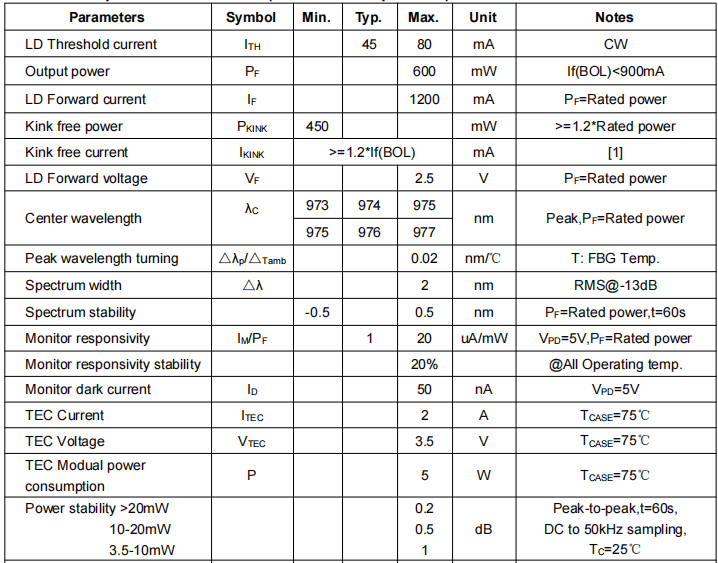
First, the 980 nm wavelength offers higher energy conversion efficiency, making pumping more "power-efficient". Erbium ions have a higher absorption coefficient for 980 nm wavelength light, meaning that for the same pump power, the 980 nm wavelength can excite erbium ions to high-energy states more efficiently with less energy loss. Taking the BFLD-980F-6HPM-N0 980 nm 600 mW pump laser as an example, its typical threshold current is only 45 mA (maximum 80 mA), and the maximum forward voltage is 2.5 V. While delivering high power output up to 600 mW kink-free, it maintains excellent electro-optical conversion efficiency, which can significantly reduce the overall power consumption of the EDFA system, aligning with the energy-saving trends in the communications industry.
Second, 980 nm pump lasers offer excellent wavelength and power stability for reliable operation. EDFA systems require continuous, stable operation 24/7, and fluctuations in wavelength and power directly affect amplification performance. The BFLD-980F-6HPM-N0 integrates FBG fiber Bragg grating wavelength stabilization technology, locking the center wavelength at 974/976 nm with a wavelength thermal drift of only 0.02 nm/°C and spectral stability controlled within ±0.5 nm. It maintains noise-free narrowband spectra under varying temperature, current, and optical feedback conditions. In terms of power stability, the module achieves 0.2 dB stability above 20 mW, 0.5 dB at 10–20 mW, and 1 dB at 3.5–10 mW, fully meeting the high stability requirements of long-haul transmission and CATV applications.
Furthermore, this module features comprehensive temperature control and monitoring design to further enhance system reliability. It integrates a TEC thermoelectric cooler, a thermistor, and a monitoring photodiode (PD). The TEC supports a maximum current of 2 A and voltage of 3.5 V, consuming only 5 W at 75°C, enabling stable wavelength locking across the operating temperature range of -5°C to 75°C. The monitor PD has a responsivity of 1–20 μA/mW and a dark current of less than 50 nA, allowing real-time and precise monitoring of output status to ensure long-term reliable operation of the EDFA. The product adopts a hermetically sealed 14-pin butterfly package with no adhesive or flux, meeting Telcordia GR-468-CORE telecom reliability standards to withstand harsh industrial environments.
With these core advantages, 980 nm pump lasers can perfectly adapt to various EDFA application scenarios, enabling full-scenario coverage. In DWDM dense wavelength division multiplexing EDFAs, low noise and stable wavelengths ensure multi-channel signal consistency; in low-pump-count EDFA architectures, the 600 mW high power reduces the number of pumps and lowers costs; in ultra-long-haul CATV trunks and high-node distribution networks, high power and reliability ensure transmission quality and low failure rates.
The BFLD-980F-6HPM-N0 uses PM980 polarization-maintaining fiber with a 1.5-meter bare fiber pigtail (no connector). It delivers kink-free power of over 450 mW (1.2 times the rated power), perfectly matching the erbium ion absorption peak. It is an ideal pump solution for EDFAs, CATV systems, and long-haul transmission, making it a cost-effective choice for communication equipment manufacturers worldwide.
In summary, 980 nm pump lasers achieve deep compatibility with the operating logic of EDFAs through high energy conversion efficiency, excellent wavelength and power stability, comprehensive temperature control and monitoring, and telecom-grade reliability. High-performance 980 nm pump modules like the BFLD-980F-6HPM-N0 have become mainstream pump solutions for EDFAs, providing key support for the high-performance, low-power, and highly reliable operation of modern optical communication systems.
Copyright @ 2020 Shenzhen Box Optronics Technology Co., Ltd. - China Fiber Optic Modules, Fiber Coupled Lasers Manufacturers, Laser Components Suppliers All Rights Reserved.