In scenarios where fiber optic sensor networks monitor the structural health of bridges and medical OCT equipment captures micron-level retinal lesions, SLED broadband light sources, with their ultra-wide spectrum, low coherence, and high stability, have become core components supporting high-precision optical systems. As a special light source between laser diodes and light-emitting diodes, these devices, through their unique light-emitting mechanism and circuit design, provide irreplaceable optical solutions for industrial monitoring, biomedicine, and national defense research.
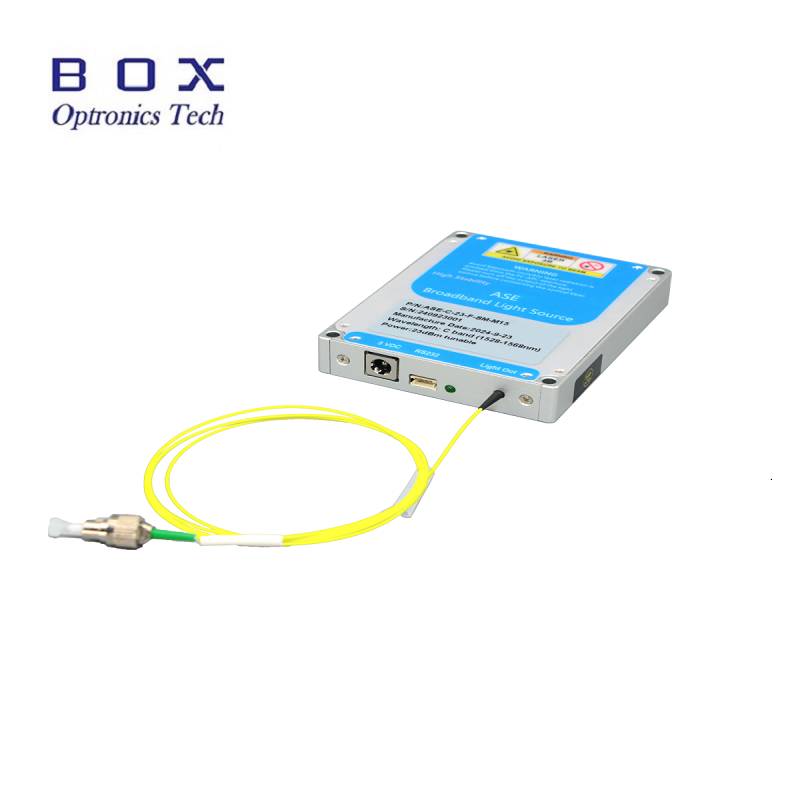
An SLED broadband light source is essentially a superluminescent light-emitting diode. Its core structure consists of a PN junction made of III-V compound semiconductors (such as GaAs and InP). When a forward bias voltage is applied to the PN junction, electrons are injected from the N-region into the P-region, and holes are injected from the P-region into the N-region. Photons are released when minority carriers recombine with majority carriers. Unlike the random spontaneous emission of ordinary LEDs, SLEDs, through optimized active region structures (such as quantum wells and strained layers), enable photons to undergo partial stimulated emission during propagation. This allows for a narrower spectral bandwidth (typically 6nm-100nm) and higher output power compared to traditional broadband light sources while maintaining low coherence.
Their spectral characteristics can be further optimized using multi-device collaborative techniques. For example, a scheme using four SLED chips, through wavelength-selective coupling, can improve spectral flatness to ≤3dB, covering the C+L band of 1528nm-1603nm, meeting the testing requirements of dense wavelength division multiplexing (DWDM) systems.
1. Spectral Performance: SLED broadband light sources typically have a 3dB bandwidth of 40nm-100nm, with center wavelengths covering commonly used communication and sensing bands such as 850nm, 1310nm, and 1550nm.
2. Spectral Density Control: Utilizing spectral flattening technology, its spectral density can be controlled within the range of -30dBm/nm to -20dBm/nm, ensuring power balance in multi-wavelength systems.
3. Power Stability: Employing ATC (Automatic Temperature Control) and APC (Automatic Power Control) closed-loop circuits, short-term power fluctuations are ≤0.02dB (15 minutes), and long-term fluctuations are ≤0.05dB (8 hours). For example, Bocos Optoelectronics' 1550nm SLED light source exhibits output power stability ≤±0.05dB/8 hours within an operating temperature range of -20℃ to 65℃.
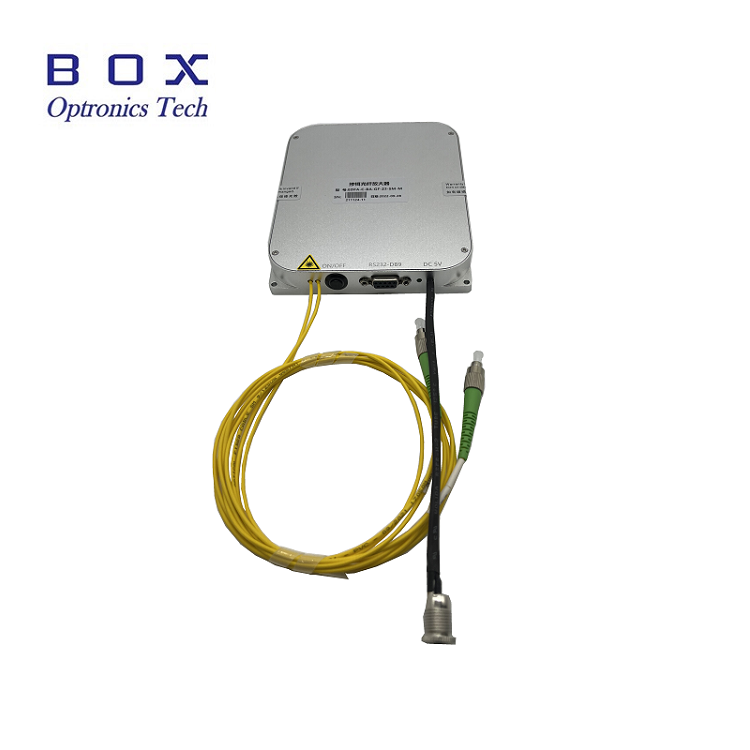
4. Modular Design: Offers both desktop (260×285×115mm) and modular (90×70×15mm) packages, supporting RS-232 interface and host computer software for remote power adjustment, spectral monitoring, and fault diagnosis.
1. Fiber Optic Sensing Systems
In distributed fiber optic sensing, the low coherence of SLEDs can eliminate interference noise caused by Rayleigh scattering, improving spatial resolution to the millimeter level. For example, in oil pipeline leak monitoring, a 1550nm SLED light source combined with an FBG sensor can detect temperature changes of 0.1℃ within a 10km range.
2. Medical Imaging (OCT)
Optical coherence tomography (OCT) relies on the coherence length and power stability of the light source. The coherence length of SLEDs (<100μm) is much lower than that of traditional lasers, avoiding artifact interference in imaging. Bocos Optoelectronics' 850nm SLED light source has been applied to ophthalmic OCT equipment, achieving 10μm-level layered imaging of the retina.
3. Optical Communication Testing
In CWDM device testing, the broad spectral characteristics of SLEDs can simultaneously cover the 800nm-1650nm band. Combined with a high-resolution spectrometer, parameters such as channel spacing and insertion loss can be accurately measured, improving testing efficiency by more than 3 times. 4. Defense Research: High-polarization SLED light sources can be used in interferometer systems for fiber optic gyroscopes. Their low-noise characteristics (RIN < -140dB/Hz) can improve angular velocity measurement accuracy to 0.01°/h.
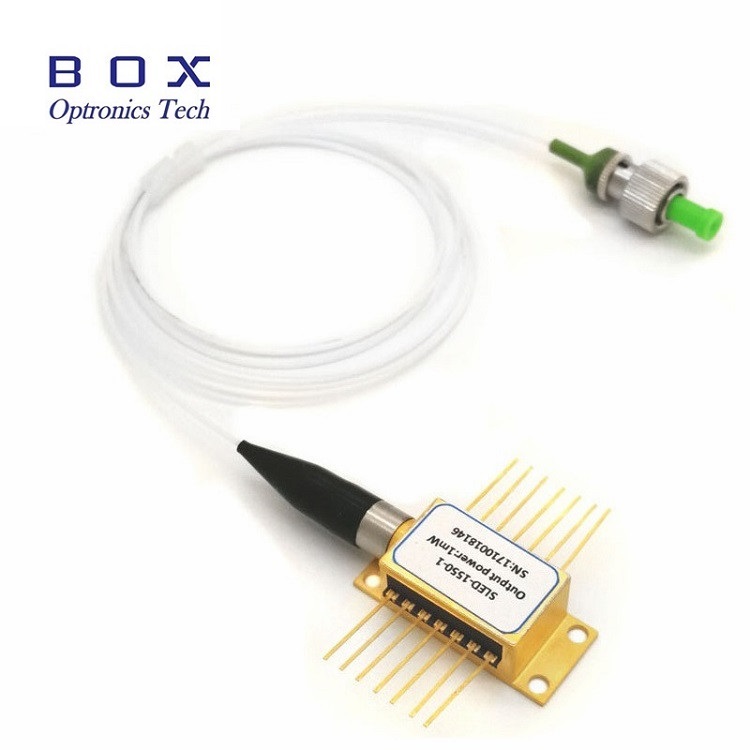
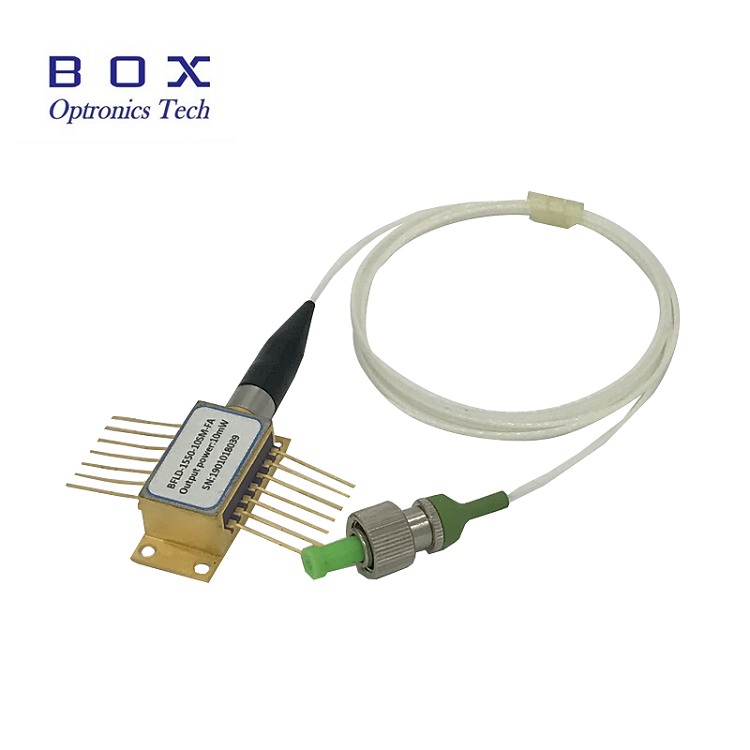
1. Butterfly Package: 14-pin butterfly package, containing a built-in thermoelectric cooler (TEC) and optical isolator.
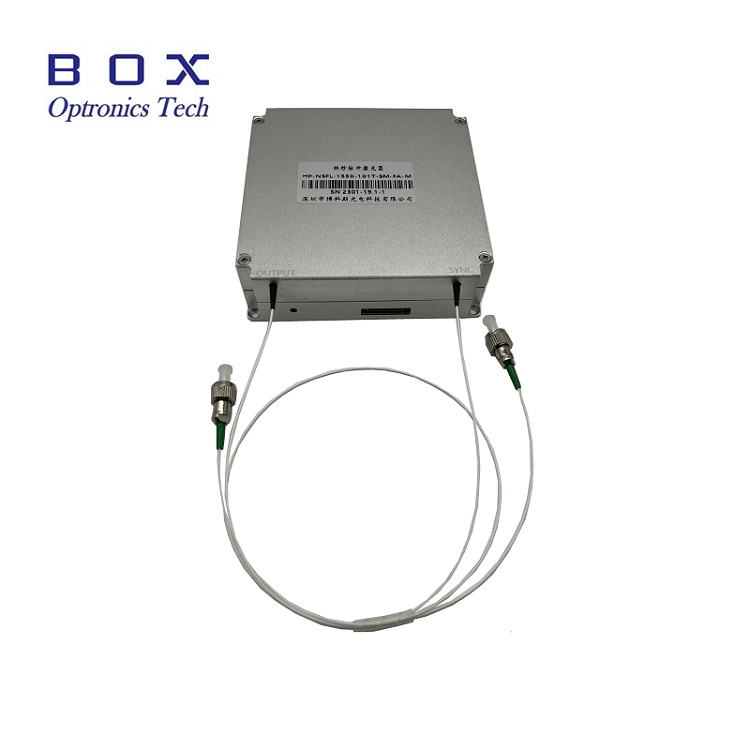
2. Desktop Package: Integrates power supply, temperature control, and communication interfaces, supporting host computer software control, suitable for laboratory research and calibration scenarios. Bocos' desktop 1550nm SLED (195(W)×220(D)×120(H)) light source is equipped with a touch screen and button operation, which can display output power, wavelength, and other parameters in real time.
3. Modular Package: Compact size (125(W)×150(D)×20(H)), can be directly embedded in industrial equipment or field testing instruments, reducing system integration costs. The module supports AC 110~240V or DC 5V/4A power supply and is suitable for storage environments ranging from -40℃ to 85℃.
Copyright @ 2020 Shenzhen Box Optronics Technology Co., Ltd. - China Fiber Optic Modules, Fiber Coupled Lasers Manufacturers, Laser Components Suppliers All Rights Reserved.